Exporting GitBook Docs as Clean Markdown with Rust
How doc-scraper-rs exports GitBook docs as a clean markdown tree with llms.txt and AGENTS.md sidecars — one request per page, no HTML parsing, and a content-based fallback for soft 404s.

Every documentation site I wanted to feed to an LLM had the same problem: the good markdown was already there, and every scraper I tried insisted on taking the scenic route through the HTML to get it.
GitBook's Next.js-rendered sites expose every page twice. Once as a fully-rendered React app — 380 to 770 KB of HTML with a hydration payload, a "Copy page" button, a feedback widget, and a Ctrl-K modal baked in. And once more as a clean text/markdown payload at the same URL with .md appended. Most scrapers hit the HTML and try to parse the result. doc-scraper-rs hits the markdown endpoint instead: one HTTP request per page, no browser, no HTML parsing, no chrome leaking into the output. What lands on disk is what the author wrote.
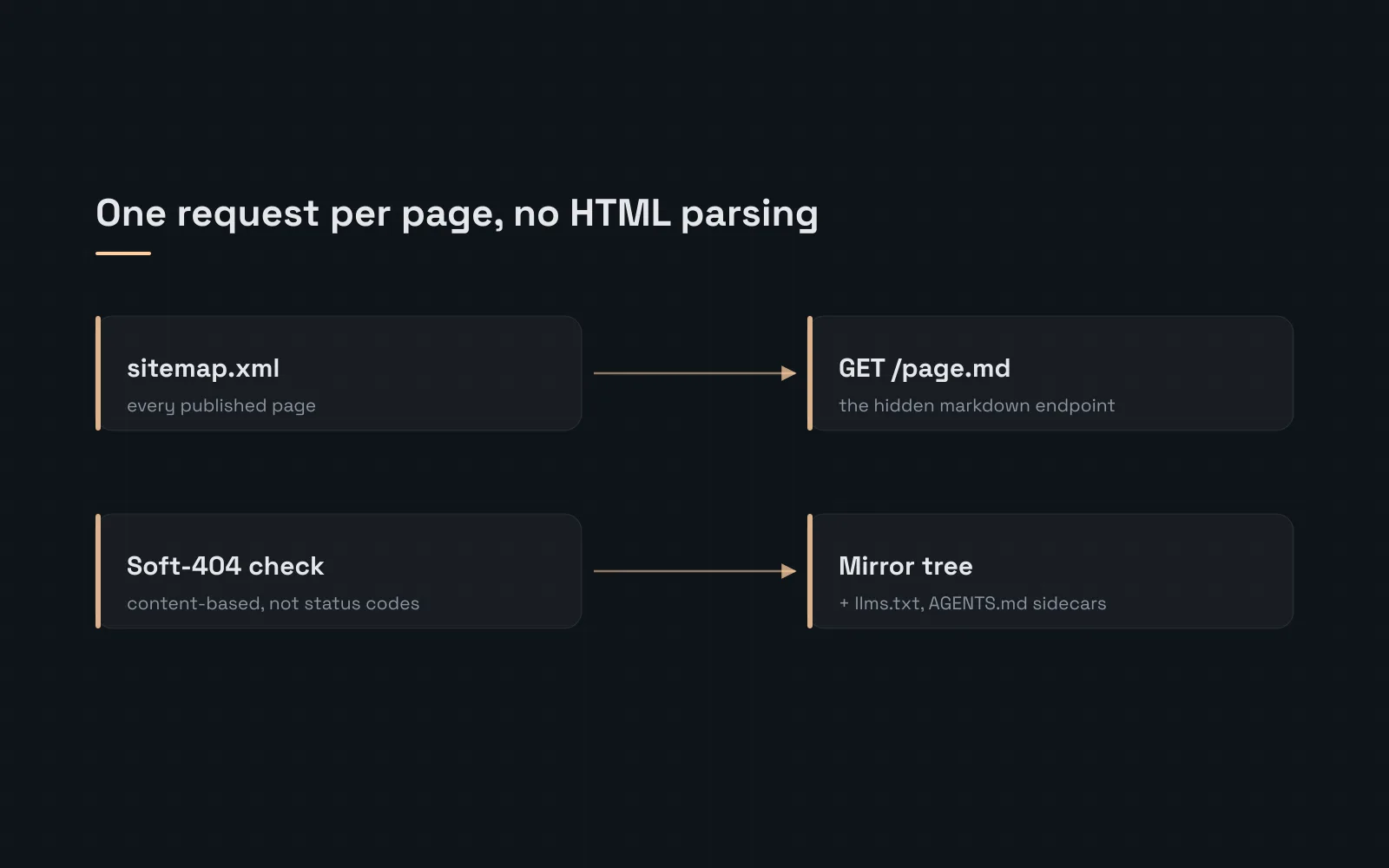
The result is a mirror tree — <output>/<url-path>/<slug>.md, shaped exactly like the site — plus a structured index.md, and three sidecars aimed directly at the AI toolchain: an llms.txt catalog, an llms-full.txt corpus, and an AGENTS.md that Claude Code, Cursor, and Copilot pick up automatically.
cargo install doc-scraper-rs

# Mirror docs.strata.markets → ./strata-docs/
doc-scraper https://docs.strata.markets
The soft 404 you can't see
The first real design problem wasn't fetching — it was trusting the fetch. When a GitBook page exists in the sitemap but its .md route isn't wired up, GitBook doesn't return a 404. It returns HTTP 200 with a "Page Not Found" markdown stub as the body. On the wire, that response looks completely healthy.
So the fallback has to be content-based. The detection is a regex anchored to the heading line — ^\s*#\s+page not found\b, case-insensitive, multiline — which is deliberately strict. Documentation about error pages legitimately contains the phrase "page not found" in prose, and a loose match would eat real pages. The regex only fires when it's the first heading, i.e. when it is the page:
static PAGE_NOT_FOUND: LazyLock<Regex> =
    LazyLock::new(|| Regex::new(r"(?im)^\s*#\s+page not found\b").expect("page-not-found regex"));
When the stub is detected, the scraper falls back to the bare HTML URL, reusing the same retry budget — and without re-paying the politeness delay, since the first request already waited. This whole path is covered by a wiremock integration test that emulates the stub end-to-end, plus a runnable smoke test in examples/soft_404_smoke.rs that pulls a real GitBook site known to return stubs on a subset of pages.
Mintlify: same trick, different lies
Once the GitBook path worked, Mintlify turned out to expose the same text/markdown endpoint — the only structural difference is the sitemap. GitBook serves a <sitemapindex> pointing at sitemap-pages.xml; Mintlify serves a flat <urlset> in /sitemap.xml. That made auto-detection trivial: parse the sitemap, look at its shape, and you know whose lies you're dealing with.
Because the lies are different. Mintlify prepends a three-line doc-index banner to every .md response — which is stripped by walking the lines literally, and if anything doesn't line up, the body is returned untouched so legitimate content is never accidentally stripped. And where GitBook's stubs fall back to HTML, Mintlify stubs are surfaced as errors instead: Mintlify stub pages have no useful content, and falling back would dump the SPA shell into the mirror tree. The stub heuristic is conservative on purpose — fewer than 100 bytes and no # heading — so a short-but-real page is never misclassified.
Politeness is a concurrency problem
The fetch fan-out is a Tokio semaphore — 20 concurrent requests by default — with a per-request politeness delay applied before every primary attempt, and bounded retries with exponential backoff on 5xx and 429. The subtlety is that the delay and the backoff stack: the effective per-request floor is the larger of the configured delay and the backoff sequence capped at 5× the delay. User-supplied negative delays are clamped to zero so neither sleep path can go negative — the kind of bug you find by writing the test that asserts the clamp.
The payoff, measured against a 34-page GitBook site on an old Intel MacBook Pro with default settings: ~172 KB of clean markdown in ~1.3 seconds — about 26 pages per second, and ~36/s with the delay off, peaking near 48/s warm. A scraper with a headless browser would still be loading its first page.
Sidecars for the machines
The markdown tree is for humans; the sidecars are for the models:
llms.txt— one line per page: title, URL, first paragraph. A navigation index a model can hold entirely in context.llms-full.txt— the entire site as one file, each page emitted as# Title,URL:, body,---. This is the file you hand to OpenAI's Files API or any RAG pipeline that wants the corpus at once.AGENTS.md+skills/— a synthesized project overview, plus per-section deep-dive files with numeric prefixes (skills/00-…md) that sort in the same order as AGENTS.md's section index. An agent reads the overview, thencats only the sections it needs instead of loading the whole corpus.
That layering — index, corpus, sections — is the whole point. Context windows are still a budget, and "all of it" is rarely the right spend.
Shipping it
The crate is 0.1.1 on crates.io, MIT-licensed, MSRV 1.85 (it uses std::sync::LazyLock rather than pulling in once_cell for two statics). Distribution goes three ways: cargo install, prebuilt binaries per platform from GitHub Releases with SHA-256 sidecars, and — the newest piece — an npm wrapper where npm install -g doc-scraper resolves the platform package via optionalDependencies, downloads the binary at install time, and verifies it. There's even a legacy HTML-scraping mode for pre–Next.js GitBook sites, though at this point it's a stub waiting for a site that actually needs it.
What I'd like next: sitemap-driven incremental re-scrapes using lastmod, and more host detection behind the same SitemapShape abstraction — the whole design treats "which documentation platform is this" as the only branching point, so adding one is adding a parser, not touching the pipeline.
If you have docs to feed to a model, try it:
doc-scraper https://docs.strata.markets -o ./strata-docs/
Repo: github.com/dibakarsutradhar/doc-scraper-rs · Crate: crates.io/crates/doc-scraper-rs